
By Bill and Sylvia Varney
Review by Steve Labinski
Putting Down Roots
It’s pretty safe to say that not all cooks are gardeners; nor are all gardeners cooks. But a passion for both gardening and cooking are often found within the same person. Many cooks develop an interest in growing fresh herbs, since it is generally accepted that fresh herbs are preferable to dried in the preparation of many dishes. Those packets of fresh herbs in the grocery stores work ok. But wouldn’t it be better to have some fresh herbs on hand?
Once started, the use and cultivation of fresh herbs is intoxicating. You’ll find that snippling chives, sage, mint, basil and the like for immediate use is a very pleasurable experience. And there is a kind of mystique surrounding herbs that goes beyond the mere flavor. There’s the scent of the plants. And each one has a long list of uses.
Soon the herb garden outgrows its confines of the sunny windowsill. Spilling outdoors, the cook becomes a gardener, too.
This is pretty much how I became interested in herbs. I coasted along for years growing and using herbs without actually knowing very much about them. My lack of knowledge led to a multitude of mistakes including planting annuals when I should have planted perennials and vice-versa, and locating shade-loving plants in sunny areas. I learned, too, that an herb grown in a pot on the windowsill would not likely remain little if grown outdoors. Herbs grown outdoors are not small plants. Fortunately, most herbs are very forgiving and will perform well, even for a non-expert like me.
I have learned a thing or two about herbs by trial and error. Since reading the book I’m reviewing today, my knowledge of growing and using all kinds of herbs has grown tenfold.
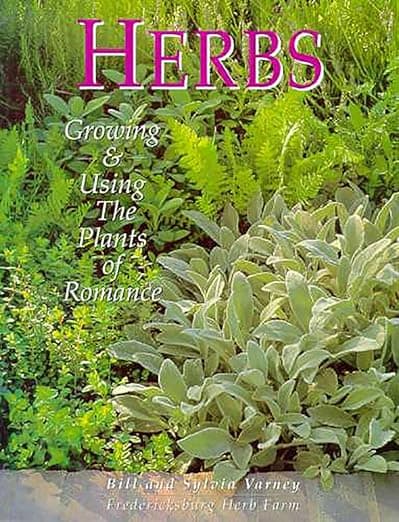
Fredericksburg is a picturesque town in the heart of the Texas Hill Country. It is the home of the Fredericksburg Herb Farm, Bill and Sylvia Varney, proprietors. The Varneys have written a book, “Herbs: Growing & Using the Plants of Romance,” that I believe to be the best and most well-presented source of information available on the subject. Masterfully photographed, it is filled with beauty, lore and practical information about the cultivation and use of hundreds of herbs.
With this book, I was able to identify a plant that has spread throughout my herb garden this year. Last August, I bought a tiny plant from the fifty-cent bin at my local nursery. It had ferny green leaves and a wonderful scent, but had lost its identifying tag. I suspected that it was an annual that would not long survive and, sure enough, after the first frost the plant died back. The plant left behind many tiny seeds. I scattered them in the hope that a few might take hold in the spring. My concerns were unfounded since, with the coming of spring, all the seeds appeared to have sprouted. And so had hundreds of the plants.
I began paging through the book to see if I could find a photograph of my mystery plant. On page 112 I found it. My mystery herb was Sweet Annie, and here is what I learned about it:
Sweet Annie
Artemisia annuaAnnual
Craft, Medicinal, Ornamental
6 to 10 feet high, to 2 feet wide
Full sun
Average to poor soil if well drained(Also known as Sweet Wormwood, Sweet Mugwort)
An attractive annual that can reach 10 feet in a season, sweet Annie is adorned with lacy, bright yellowish green leaves that have a sweet, basil and honeylike fragrance. The entire plant turns a beautiful red with cool crisp weather in fall. Spikes of small yellowish green flowers on typically reddish stems appear in midsummer.
Native to southern Europe and western Asia, sweet Annie often grows as a weed in disturbed soils. At some point plants were carried to China, perhaps as seeds stuck to Mongol saddle cloths. The Chinese were quick to incorporate sweet Annie into their pharmacopoeia. They used it to treat jaundice and malaria, as well as to stop bleeding of wounds.
Planting and Care — Sow seed in place in fall or start seed indoors in early spring, but seedlings typically do not transplant well. Overplant, then thin survivors to 1-1/2 to 2 feet apart. Locate in full sun in any well-drained soil. Survives with little water but performs best with regular irrigation. Plants self-seed prolifically. [Note from P. Mitchell: Ill vouch for that.]
Harvesting and Use — Leaves can be picked before flowering or whole plant can be cut when flowering peaks. Leaves have a sweet fragrance and are wonderful in potpourri. An herbal bath with sweet Annie and chamomile helps relieve muscle aches. The slender, feather-leaved stalks dry well and add a nice texture to informal arrangements. See photos, page 169. Keep a wreath of Sweet Annie in the bathroom; the steam will cause it to release its wonderful, herbal fragrance. Caution: Pregnant women should not use sweet Annie.
Theres another Sweet Annie caution to pollen-sensitive people, together with measures that can be taken to prevent pollen from dispersing. If that’s not enough, the book contains step-by-step instructions, photographs, for Making an Herb Wreath using Sweet Annie and other herbs.
The book is organized in such a way that order is brought to the subject reducing it to the dry dimensions of a kind of “dictionary”.
Making Sense of Herbs, the first section, is devoted to the Fredericksburg Herb Farm. We learn how the Varneys have transformed the farm into the 14-acre attraction that it is today.
Whos Who in the Herb Garden contains lists of mainstay herbs in all the varieties: culinary, medicinal, cosmetic, decorative and landscape, as well as cross-referenced lists in other categories. This incudes Perennial Herbs, Annual Herbs, Herbs for Shade, Herbs to Plant Near Paths and Herbs by Color. The section describing the Mainstay Cosmetic Herbs, for instance, contains a recipe for a Natural Body Scrub. The ingredients are sugar, rosemary, sea salt, thyme and oatmeal and I’m dying to try it.
The next section, Gallery of Herbs, is the books largest. It contains complete descriptions of how to grow and use more than 100 herbs.
Framework for a Garden is the section to consult when beginning to plan your herb garden.
Putting Down Roots is the books guide to growing herbs. Again, there are useful lists (Easy to Grow from Seed, Herbs to Match Your Soil, Herbs That Help Repel Pests), together with information on planting, propagating, growing, maintaining, weeding, feeding, dealing with garden pests, and reaping and keeping. This section is interspersed with particularly illustrative photos.
The Herbal How-to Recipes section is not merely a cookbook in its own right. It is a guide for concocting luxurious potions, potpourris and bath-time splashes and oils. This is where I found the instructions for my herb wreath.
The book ends with a Sources page and full index.
As mentioned above, the book is beautifully and lavishly photographed. Most photographs were taken on location at the Fredericksburg Herb Farm. Viewing them at length will make you want to go there. And the nice thing is that you can go there. (For information about the Fredericksburg Herb Farm, visit their informative and lovely web site at http://fredericksburgherbfarm.com)
I have seldom been as enthusiastic about reviewing a book as I have this one. “Herbs: Growing & Using the Plants of Romance” is a book to be read with pleasure and used with equal enjoyment.
Book Herbs: Growing & Using the Plants of Romance
Softcover 176 pages
Publisher Univ of Arizona Press
1998-12-01