
The Klan Fighting Governor of Texas
Eakin Press – 167 pages. (1998)
By Ken Anderson
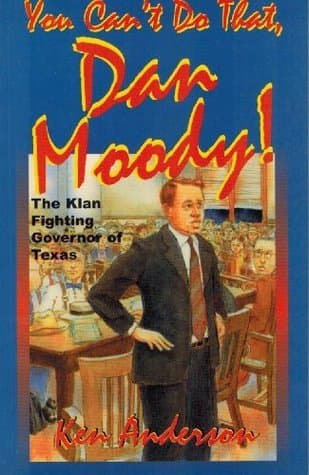
This month we explore the law and the lawlessness of Texas. We review two books from the Eakin Press – You Can’t Do That, Dan Moody by Ken Anderson and Gamblers & Gangsters: Fort Worth’s Jacksboro Highway in the 1940’s and 1950’s by Ann Arnold. Both writers reside in the areas of the state where the stories in their books occur. Ken Anderson is currently an assistant district attorney in Georgetown, TX.
(The same job, as a matter of fact, that Dan Moody had in the 1920’s. Ann Arnold is a long-time Fort Worth resident who has written much about the city and its historical figures.
Ken Anderson’s book on Texas Governor Dan Moody tells a great story which, as a life-long Texas resident, I did not know. Perhaps I was sleeping through that week in my Texas History class in junior high.
In the 1920’s the Klu Klux Klan was thriving all over the South. Anderson details the formation of a very active Klan chapter in Moody’s Williamson County, about 40 miles north of Austin, TX.
The Klan’s appeal as a secret society was strong. The group purported to protect what was seen as declining morals and an American way of life. Most of Anderson’s book details the case and trail involving the brutal assult of R. W. Burleson, a traveling salesman who local Klansmen assumed was having a adulterous affair with a local widow. At that time, no member of the Klan had ever been brought to justice or served a day in jail. (Hence the book title – You Can’t Do That, Dan Moody!)
During this time, Dan Moody was a young district attorney for Williamson County. Moody prosecuted the case despite overwhelming popular sentiment that it is impossible for a jury conviction in such a trial. Moody quickly found many of his witnesses sympathizing with the Klan.
The defense found and brought forth people who would lie or distort facts in order to protect the Klan. The defense hired some of the best criminal defense lawyers, including a popular sitting Texas Senator.
Anderson moves us through the trial, bringing all the characters to life with back-and-forth dialogue. I enjoyed following the story, and learned a great deal about the way cases were tried back then. I was reminded of an historical, Texas-style episode of the TV drama Law & Order.
At 157 pages, the book is primarily intended as a children’s book. However I found it to be a nice addition to my own Texas history bookshelf. The book makes a great gift for any kid who could find an interest in the law or just in reading about courageous people like Dan Moody. Anderson’s interesting story of Dan Moody makes “You Can’t Do That, Dan Moody!” worthwhile for adults as well.